





Warehouse Marking & Inventory Identification System
Warehouse marking enables identification of products, pallets, storage locations, zones, and movement operations within a unified inventory system.
Warehouse marking connects physical objects with digital systems: products, packaging, pallets, containers, storage locations, and documents. Technologies such as barcodes, QR/DataMatrix, and RFID are used for this purpose.
Warehouse marking is part of a broader marking and identification system and works together with data capture equipment such as scanners, mobile terminals, label printers, and weighing systems.
What is marked in a warehouse
- products and packaging;
- pallets and containers;
- storage locations (bins, shelves, racks);
- warehouse zones;
- batches and serial numbers;
- returnable containers;
- receiving and shipping documents.
Why warehouse marking is important
- faster receiving and shipping processes;
- reduced errors in movements;
- accurate stock and location control;
- fast inventory counting;
- batch and serial traceability;
- integration with production and sales processes.
Warehouse marking technologies
| Technology | Application |
|---|---|
| Barcode | basic tracking of products, boxes, and locations |
| QR / DataMatrix | compact codes, extended data, links to digital records |
| RFID | mass reading, automated tracking, inventory automation |
| Labels | physical carrier of codes and additional information |
Storage location labeling
Location labeling enables structured (address-based) storage. Each location is assigned a unique identifier used for put-away, picking, movement, and inventory processes.
It is important to select the correct label, material, size, and placement to ensure durability and readability in real warehouse conditions.
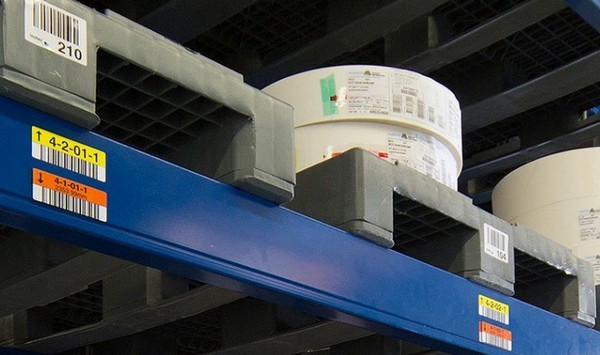
Rack level marking
Rack level marking using color zones and barcodes improves accuracy of storage, simplifies forklift operations, and speeds up put-away and picking processes.
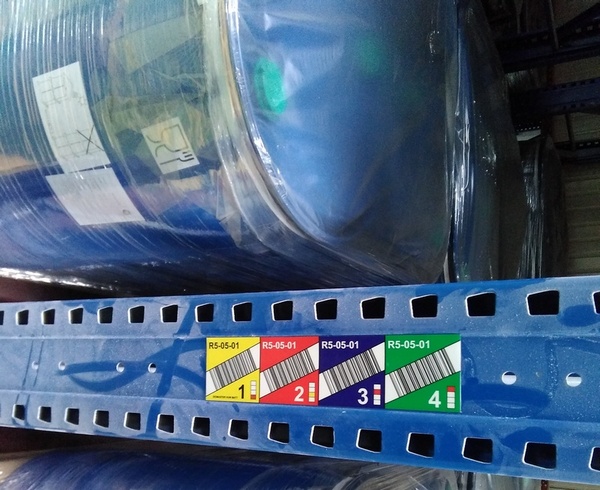
Pallet and packaging labeling
Pallet labeling allows grouping multiple items into a single logistics unit. This simplifies receiving, storage, movement, and shipping operations.
Depending on the requirements, pallets may be labeled with barcodes, QR codes, or RFID tags for automated identification.
Marking and weighing integration
Warehouse marking is often integrated with weighing systems. For example, during receiving or shipping, the system can identify the object and record its weight simultaneously.
This turns weighing into a full inventory transaction: object identified, weight captured, and data stored in the system.
Typical workflow
- Product or pallet receives a unique identifier.
- Operator scans the code during receiving or movement.
- The system identifies the object and its status.
- Weight or quantity is recorded if required.
- The transaction is stored in the system.
- Data is used for stock control, reporting, and analytics.
Common mistakes in warehouse marking
- using identical codes for different objects;
- incorrect label material selection;
- poor code readability;
- lack of coding standards;
- no integration with inventory systems;
- placing labels in areas prone to damage;
- attempting automation without location-based storage.
Vostok-IT approach
Vostok-IT considers warehouse marking as part of a complete automation system. We analyze warehouse processes, select identification technologies, choose materials and equipment, and design integration with enterprise systems.
- warehouse process analysis;
- coding structure design;
- selection of labels and equipment;
- scanning validation;
- system integration;
- pilot implementation and scaling.