





Stainless Steel Scales for Manufacturing and Industrial Enterprises
Stainless steel scales are one of the most common requests from manufacturing and industrial businesses. In practice, however, the request for stainless steel weighing equipment is not only about the material itself. It is primarily about ensuring stable and reliable accounting of raw materials, semi-finished products, and finished goods in environments with moisture, washdown procedures, disinfection, and aggressive chemicals.
That is why the choice of scales should not be based on platform material alone. It is equally important to evaluate the reliability of the complete system: load cells, cabling, junction boxes, connectors, weighing terminal, and the quality of the metal structure itself. In automated accounting systems, scales are not just equipment — they are a critical source of primary data for operator workstations, production accounting, raw material control, filling operations, and finished goods verification.
Where stainless steel industrial scales are used
Stainless steel scales are most commonly used in:
- food processing plants;
- meat and fish processing facilities;
- dairy production;
- pharmaceutical manufacturing;
- chemical industry;
- cosmetics and household chemicals production.
The main reasons for choosing this type of design are high humidity, frequent washdown, use of disinfectants, and the need for corrosion resistance.
Main types of stainless steel scales
1. Fully stainless steel design
This is the TOP-level solution, where load cells, frame, platform, and weighing terminal are all made of stainless steel. These scales are intended for the harshest operating conditions and typically offer IP66, IP67, or IP68 protection.
This configuration is recommended for areas with intensive washdown, strict sanitary requirements, and постоянным воздействием влаги and chemically aggressive substances.
2. Combined design: stainless platform with galvanized frame
In this version, load cells, platform, and terminal are made of stainless steel, while the frame is galvanized steel. This solution provides strong protection against harsh environments while costing significantly less than a fully stainless steel scale.
For many production sites, this option becomes the optimal balance between cost and durability.
3. Partially stainless steel design
In this configuration, load cells, weighing terminal, and platform cover are made of stainless steel, while the frame is made of powder-coated painted steel.
Such scales are suitable for production zones with moderate exposure, where resistance to external factors is important, but budget optimization also matters.
Practical operating experience: where the real problems occur
Experience gained from implementing and operating automated workstations for raw materials, semi-finished products, and finished goods accounting shows that reliability does not depend on stainless steel alone.
The most common causes of failure are:
- damage to load cell cables;
- microcracks in cable insulation;
- loss of sealing in connectors;
- moisture and chemicals entering connection points;
- corrosion and failure of weld seams in low-cost models.
In many cases, cable infrastructure and connector protection become the weakest point, even in fully stainless steel scales. Once the cable jacket or connector sealing is damaged, signal degradation begins, readings start to drift, and weighing data becomes unreliable.
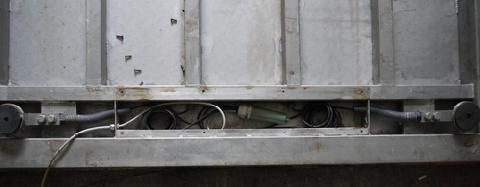
Another common issue in low-cost stainless steel scales is the mismatch between frame materials and welding consumables. In such cases, weld seams become vulnerable to corrosion, microcracks appear over time, and the scale starts producing unstable results.
Scales as part of an automated workstation
At modern industrial enterprises, scales should be treated as part of an automated accounting workstation, not as standalone equipment. A weighing point is usually integrated with:
- the operator workstation;
- the enterprise accounting system;
- MES / EAM / ERP platforms;
- barcode scanners and RFID devices;
- marking and traceability systems.
As a result, every weighing operation can be recorded together with the raw material, batch, semi-finished product, finished goods unit, container, employee, and production operation. This is what creates real accounting transparency and production control.
Why the right accuracy class matters
For industrial enterprises, it is important that professional weighing equipment is available in different accuracy classes:
- standard industrial accuracy;
- high accuracy;
- precision platforms for industrial applications.
This makes it possible to equip each workstation according to its technological purpose. Some areas only need standard industrial accuracy, others justify the use of higher-accuracy scales, and certain critical operations require precision weighing platforms.
For example, upgrading from standard industrial scales to higher-accuracy equipment at food filling stations often pays back within 6 to 18 months due to lower hidden losses, reduced product giveaway, and more consistent product quality.
Why manufacturers choose solutions from leading brands
If an enterprise operates under harsh industrial conditions, stainless steel scales should be selected from manufacturers capable of providing full quality control over all components: metal structures, load cells, cables, junction boxes, terminals, and sealed connections.
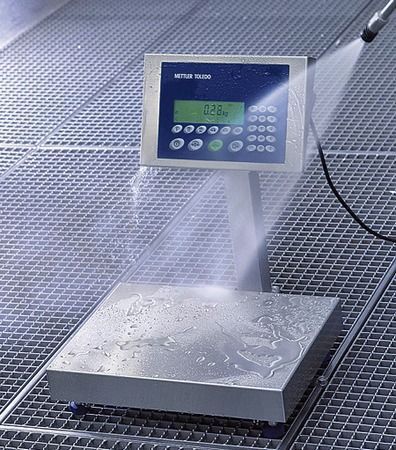
One of the highest-quality brands in this segment is widely considered to be Mettler Toledo. Their strengths are especially important where the following matter most:
- stable performance in aggressive environments;
- long service life;
- accurate weighing and accounting;
- minimized downtime and service calls;
- integration into automated accounting systems.
How to choose the right scales for production
The correct choice does not begin with the question “stainless steel or not.” It begins with analysis of:
- actual operating conditions;
- washdown frequency and chemical exposure;
- required weighing accuracy;
- the role of the scales in the accounting process;
- integration requirements for workstations and enterprise systems.
In many cases, the most expensive design is not required for every control point. A far more efficient approach is to design the weighing system by areas: where TOP-level protection is necessary, where a combined design is sufficient, and where a partially stainless solution is enough.
Conclusion
Stainless steel scales are an important part of modern production accounting. However, reliability and economic efficiency depend not only on the metal, but on the quality of the complete structure, all components, and how correctly the scales are integrated into automated workstations for raw materials, semi-finished products, and finished goods control.
That is why the best strategy for industrial enterprises is not simply to buy “stainless steel scales,” but to design a system of control points and automated workstations, select the right accuracy class, and choose reliable equipment for the real operating environment.
See also

Products