




GTIN — Global Trade Item Number
GTIN is a globally recognized number used to uniquely identify trade items across retail, logistics, e-commerce, warehouse operations and supply chain information systems.
The abbreviation stands for Global Trade Item Number. A GTIN is assigned to a product or service that may be priced, ordered, sold, shipped, invoiced or otherwise managed within a commercial process.
Using a standard global identifier makes it possible to recognize the same trade item consistently across countries, marketplaces, retailers, distributors, warehouses and enterprise systems.
What is the difference between a GTIN and a barcode?
A GTIN is the identification number, while a barcode is one of the methods used to encode and capture that number.
For example, a GTIN-13 may be printed on a consumer package as an EAN-13 barcode. The numeric value printed below the bars is the GTIN, while the barcode symbol allows scanners and imaging devices to capture it automatically.
GTINs may also be encoded in different GS1 data carriers, including:
- EAN-8 and EAN-13;
- UPC-A and UPC-E;
- ITF-14;
- GS1-128;
- GS1 DataMatrix;
- GS1 DataBar;
- QR codes using GS1 Digital Link syntax.
The appropriate data carrier depends on the product type, package size, supply chain level, scanning environment and the amount of information that must be encoded.
Main GTIN formats
The GS1 system supports several GTIN formats:
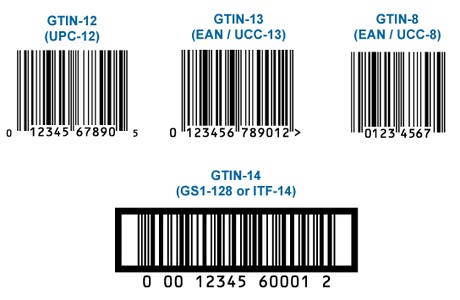
- GTIN-8 — an eight-digit number used for small consumer items where there is not enough space for a standard EAN-13 barcode;
- GTIN-12 — a twelve-digit number commonly encoded in a UPC-A barcode and widely used in North America;
- GTIN-13 — a thirteen-digit number commonly used for consumer products and encoded in an EAN-13 barcode;
- GTIN-14 — a fourteen-digit number mainly used for cases, cartons and other higher packaging levels.
GTIN-8, GTIN-12, GTIN-13 and GTIN-14 are different formats of the same global trade item identification system.
GTIN structure
The exact structure depends on the GTIN format, but it generally contains:
- a GS1 Company Prefix — allocated to an organisation by a GS1 Member Organisation;
- an item reference — assigned by the brand owner to identify a specific trade item;
- a check digit — the final digit, calculated using a standard algorithm to detect data entry or scanning errors.
The first digits of a GTIN should not be interpreted as a reliable indication of the country of manufacture. They identify the GS1 organisation through which the company prefix was allocated, while the product itself may be manufactured in another country.
Who assigns a GTIN?
In most cases, the GTIN is assigned by the brand owner or the organisation responsible for defining the product and placing it on the market under its name.
To obtain a GS1 Company Prefix or another authorised numbering capacity, a business normally registers with its national GS1 Member Organisation. The company can then create unique GTINs for its products according to GS1 rules.
GTINs should not be invented arbitrarily or copied from other products. Incorrect identification may cause listing errors, rejected shipments, duplicate catalogue records and problems in retail, e-commerce, warehouse and ERP systems.
When do different products need different GTINs?
A separate GTIN is required for each trade item that customers or supply chain partners need to distinguish from another.
Different GTINs are commonly required when products vary by:
- model or product name;
- size;
- colour;
- flavour or fragrance;
- composition or functionality;
- declared weight, volume or quantity;
- pack configuration;
- packaging level;
- primary brand.
A new product requires a new GTIN. A new GTIN may also be needed when an existing product undergoes a significant change that affects how customers or trading partners distinguish it.
GTINs for individual products, cases and pallets
The same product may be handled at several packaging levels:
- an individual consumer unit;
- a multipack;
- a transport case or carton;
- a pallet configuration.
Each packaging level that is separately priced, ordered, handled, stored or shipped may require its own GTIN.
For example, a single beverage bottle, a six-pack and a transport carton containing several six-packs are different trade items from a logistics perspective and should be identified separately.
GTIN-14 is commonly used for cases and higher packaging levels that are not normally scanned at a conventional retail checkout.
Where GTINs are used
GTINs support a wide range of commercial and operational processes:
- retail point-of-sale scanning;
- product listing in online marketplaces;
- warehouse and inventory management;
- receiving, picking and shipping operations;
- purchase orders and electronic invoices;
- ERP, WMS and product information systems;
- data exchange between manufacturers, distributors and retailers;
- product traceability and recall processes;
- catalogue and master data management.
A shared identifier helps connect the physical product with the correct digital record and reduces errors when product information is exchanged between different systems and organisations.
GTIN and additional product data
A standard GTIN identifies the type of trade item. By itself, it does not identify an individual unit and does not include information such as a batch number, expiry date or serial number.
For more detailed identification and traceability, the GTIN may be used together with:
- a batch or lot number;
- a serial number;
- a production date;
- an expiry date;
- a variable weight value;
- other data defined by GS1 Application Identifiers.
This information can be encoded in GS1-128, GS1 DataMatrix, GS1 DataBar or other two-dimensional symbols. Such combinations support batch traceability, serialisation, expiry date control and targeted product recalls.
GTIN in product traceability and digital product information
GTIN often serves as the primary reference identifier in product traceability and product information systems. After a barcode or two-dimensional code is scanned, the system can retrieve the corresponding product record and perform the required operation.
Depending on the project, scanning may initiate:
- a sale or checkout transaction;
- goods receiving;
- warehouse movement;
- inventory counting;
- picking and dispatch;
- batch verification;
- access to product information.
For products that require more than basic identification, GTIN can also be connected to a digital product page or web passport. This may give customers, distributors, service partners or auditors access to verified product information, certificates, instructions, origin data, warranty details or authenticity verification.
The Original Webrozum platform can be used as an additional digital layer within such projects. A GTIN, QR code, Data Matrix, RFID or NFC identifier may link the physical product to a controlled web-based product passport without changing the role of GTIN as the standard trade item identifier.
Implementing GTIN-based identification
A successful implementation usually requires several coordinated steps:
- creating and maintaining a reliable product master database;
- obtaining and assigning valid GTINs;
- selecting the appropriate barcode or two-dimensional symbol;
- preparing and testing the label design;
- selecting scanners, mobile terminals or fixed readers;
- integrating captured data with ERP, WMS, retail or traceability systems;
- testing barcode quality on actual products and packaging.
Vostok IT supports product identification and traceability projects, including barcode implementation, label printing, equipment selection, system integration and the creation of digital product passports where additional product information or market interaction is required.