



RFID in the warehouse
RFID technologies in the warehouse are used to automate accounting, movement control, transport dispatching, identification of logistics units, and reduction of errors during warehouse operations. Depending on the company’s tasks, RFID can be used as an independent control tool or as an additional technological layer for WMS, ERP, barcode labeling, and video surveillance systems.
In practice, RFID does not always replace barcodes, QR codes, or DataMatrix codes. Most often, radio frequency identification complements existing accounting schemes, speeds up operations, provides background control, and helps automatically record events that may be missed during manual scanning.
Main RFID applications in a warehouse
- RFID transport control;
- RFID portals, or RFID gates, at doors and loading docks;
- handheld RFID readers and data collection terminals;
- mobile forklifts with RFID systems;
- RFID labeling of logistics units during order picking;
- RFID control of containers, pallets, boxes, and warehouse storage locations.
RFID transport control
In many projects, RFID transport control is one of the clearest and most effective ways to begin implementing an RFID-based accounting system. First of all, this applies to the automation of vehicle control at checkpoints, truck scales, loading and unloading areas, and vehicle traffic zones within a warehouse complex.
The RFID system automatically records vehicle arrival and departure, passage through control points, time spent on the territory, and arrival at a loading dock or truck scale. This makes it possible to organize transport dispatching, control the timing of logistics operations, and manage vehicle traffic within the warehouse or production site.
In some cases, existing technical passes for trucks are already equipped with RFID tags and can be used as ready-made identifiers. This reduces the cost of additional vehicle labeling. If the company has its own fleet, RFID tags can also be installed on trailers, semi-trailers, containers, and other transport units. This approach makes it possible to control not only the arrival of the vehicle, but also the actual movement of a specific logistics unit.
RFID transport control is especially useful when working with truck scales. The system can automatically identify the vehicle, record the weighing event, and link the data to documents, a trip, an order, or a delivery. This reduces the influence of the human factor and speeds up control operations.
RFID control of railway transport
The situation with RFID control of railway transport is more complex. Technically, automatic identification of railcars, locomotives, and seals is possible. However, in many countries there is no single mandatory standard for equipping railcars with RFID tags. Different industries and companies try to label railcars in their own way, while the railway operator may require the removal of “extra” tags, including barcode labels, when accepting railcars.
Therefore, RFID accounting of railway transport is more often considered within local projects: on closed enterprise territories, industrial sites, terminals, quarries, metallurgical plants, and cement plants. For full-scale implementation, unified standardization at the railway infrastructure level is required, but in many countries this task has remained unresolved for decades.
RFID portals, or gates, for doors and loading docks
RFID portals are used at loading docks, checkpoints, internal warehouse doors, and control points to automatically record the movement of pallets, containers, cages, carts, boxes, and other logistics units.
Important: an RFID portal usually reads the tag of a pallet position or logistics unit, not all RFID tags of the goods inside it. The system controls the movement of the logistics unit itself. The list of contents is created and verified at the stages of picking, kitting, packing, unpacking, or receiving the pallet position.
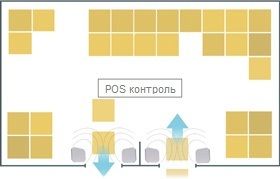
Entry and exit control points can be arranged at the same door. This makes it possible to determine the direction of cargo movement and automatically record the event of passing through the control zone.
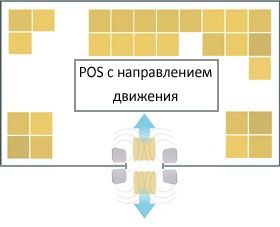
Equipping loading and unloading doors with RFID portals provides automatic control of pallet and transport container movement. The system records the arrival and departure time of goods, passage through control zones, movement between warehouse areas, as well as unpacking, placement, or dispatch operations for logistics units.
From an architectural point of view, RFID portals are an integrated software and hardware solution. They include RFID readers, antennas, controllers, communication server software, a central database, and autonomous local databases that allow the system to continue operating in case of temporary loss of connection to the central database. Integration solutions are also implemented for data exchange with the company’s accounting systems: WMS, ERP, EAM, MES/MAS, and other software platforms.
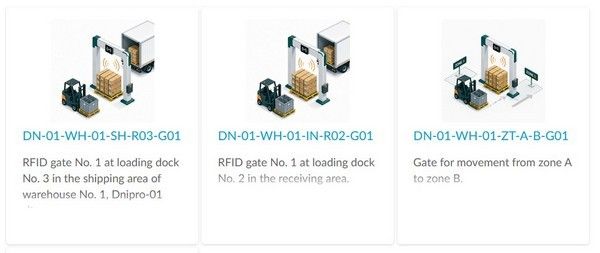
The task of the RFID server software is to ensure uninterrupted operation of the RFID circuit: reading RFID tags, processing events, recording data in the database, exchanging information with accounting systems, and controlling external devices such as barriers, traffic lights, signal towers, displays, sound alarms, and light indication.
Important: all warehouse business logic remains on the side of the accounting software — WMS, ERP, EAM, or another warehouse accounting system. The RFID subsystem does not replace the accounting system. It ensures operation of the radio frequency identification circuit: reading tags, transmitting events, confirming passage through control points, and exchanging data with accounting software.
An RFID portal can operate as the main automatic accounting point or as a shadow backup system for manual scanning of logistics numbers. In the second case, the system helps detect missed manual scanning operations and discrepancies between the actual movement of goods and the data in WMS or ERP.
Handheld RFID readers
Handheld RFID readers and data collection terminals with an RFID module allow employees to work with RFID tags, barcodes, QR codes, and DataMatrix codes using a single device. This is convenient for warehouses where several identification technologies are used at the same time.
Handheld RFID readers are used for receiving, inventory, product search, shipment control, pallet verification, work with transport containers, and clarification of data in disputed situations. They can be used by warehouse operators, order pickers, receiving area employees, mobile forklift drivers, and personnel responsible for shipment control.
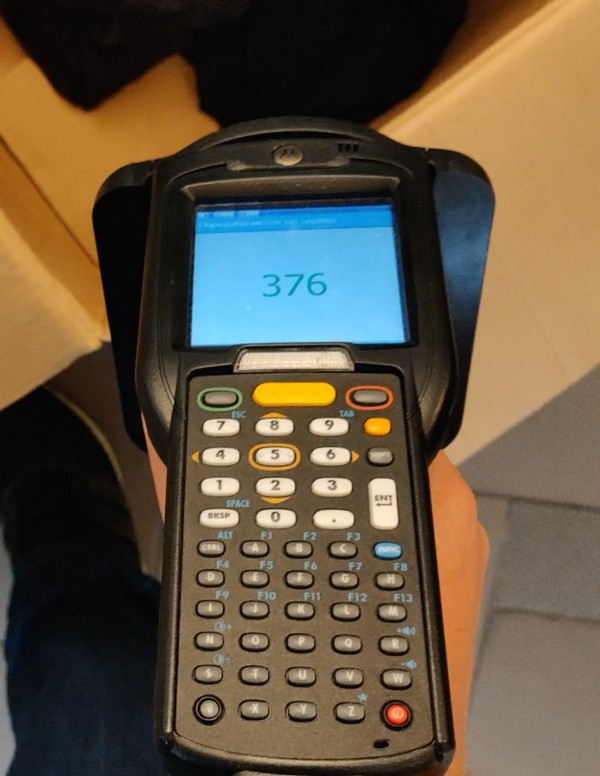
As a rule, RFID identification does not fully replace barcode labeling, but complements it. A barcode, QR code, or DataMatrix code is convenient for precise visual control and targeted scanning operations. RFID is useful when it is necessary to quickly read a tag without direct line of sight, perform group reading, find an object, or automatically confirm the fact of movement.
A handheld RFID reader is also used when reading failures occur at an RFID portal. With its help, an employee can check the RFID tag of a pallet position, clarify the cause of the failure, identify a damaged tag, detect a placement error, or find a problem with the reading zone settings.
Mobile forklifts with RFID systems
Equipping mobile forklifts with RFID systems makes it possible to organize both background control of warehouse operations and primary accounting of goods placement. This approach is especially useful in warehouses with a large number of pallets, containers, returnable packaging, and storage zones.
In the basic version, the RFID reader on the forklift transmits tag data when the tag appears in the reading zone and records the moment when the tag disappears from that zone. These data can be compared with other events: scanning the barcode of the storage location, forklift location coordinates, WMS data, RFID portal readings, and video surveillance.
This scenario helps detect placement errors and find “lost” goods — cargo that was physically moved but was not correctly recorded in the system. It also helps control cases where the forklift driver did not specify the storage location code. If a tag stops being read in a certain zone, the system can approximately determine the coordinates of the cargo placement.
Coordinate-based RFID warehouse control
The next level of automation is coordinate-based RFID control. Full RFID control of a warehouse facility is possible when storage zones, racks, rows, shelves, cells, containers, and logistics units are labeled with RFID tags, and warehouse equipment is equipped with RFID readers.
Ideally, the RFID system is integrated with WMS, a positioning system for warehouse equipment and employees, and a video surveillance system. Only an integrated approach makes it possible to compare RFID events, operator actions, equipment movements, accounting data, and the actual situation in the warehouse.
The implementation of a coordinate-based RFID system begins with warehouse labeling. Rack storage locations — rows, sections, shelves, cells, and zones — are equipped with RFID tags. Passive RFID tags are relatively inexpensive, so the warehouse coordinate grid can be sufficiently detailed.
For the coordinate grid to work, mobile forklifts are additionally equipped with RFID readers and antennas. When products are moved on pallets, in containers, or in boxes, the system can record the RFID tag number of the container and the RFID tag number of the storage cell.
Several antennas can be installed on the forklift for this purpose:
- the first antenna reads the RFID tag of the cargo or container being moved;
- the second antenna reads the RFID tag of the storage cell or zone;
- the third antenna can be used to read floor RFID tags and clarify the forklift movement route.
RFID does not replace WMS, but complements it
Important: implementing an RFID system in a warehouse does not replace a WMS or ERP system. It complements the warehouse accounting circuit with radio frequency identification technology. Effective RFID operation requires integration with the company’s accounting system, refinement of business logic, configuration of events, control rules, and exception handling scenarios.
Even after RFID implementation, all key warehouse objects should preferably be labeled with barcodes or 2D codes: goods, storage locations, transport containers, pallets, containers, and logistics units. This provides a backup, visually understandable, and technologically reliable method of identification.
RFID is especially effective where it is necessary to speed up operations, automate movement control, reduce the number of manual scans, and receive event data in the background. Barcodes and 2D codes remain important for precise operation confirmation, document processing, packaging control, and interaction with personnel.
RFID labeling during order picking
One common scenario for using RFID in a warehouse is the control of order picking and movement of logistics units. The workflow may be as follows: first, the employee scans the storage location number, then the barcode or 2D code of the product, and after that the code of the box, container, or pallet into which the order is placed. The software records where and what was taken and adds the item to the order.
RFID can be used in this scenario in different ways. In one option, the system expects the RFID tag of the box or pallet with the picked order. In another option, RFID tags of goods, contents, or transport containers are additionally read. After passing through the RFID portal, the system confirms correct order picking and sends the order to the packing, control, or shipping area.
When forming a pallet or container, the collected batch of goods can be “linked” to the RFID tag of the logistics unit. After this tag crosses a control point, the entire batch of goods is automatically considered moved, shipped, or transferred to the next area.
RFID tags for warehouse applications
Different types of RFID tags are used to label products, packaging, transport containers, pallets, racks, storage cells, and equipment. The choice of tag depends on the surface material, operating conditions, required reading distance, fastening method, presence of metal, moisture, dust, mechanical loads, and temperature factors.
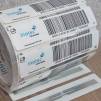
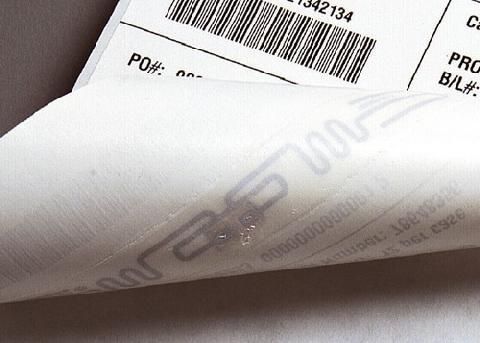
Self-adhesive RFID labels are most often used for product labeling. Variable information is printed on such labels using an RFID printer. This is a thermal transfer label printer additionally equipped with an RFID module for writing and verifying the RFID chip.
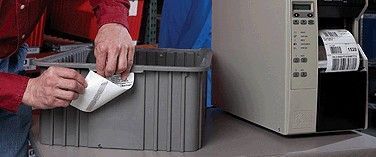
For transport containers, pallets, metal objects, and returnable equipment, RFID tags in special housings are used. The housing protects the RFID chip and antenna from mechanical damage, moisture, dirt, and allows the tag to be securely attached to the object.
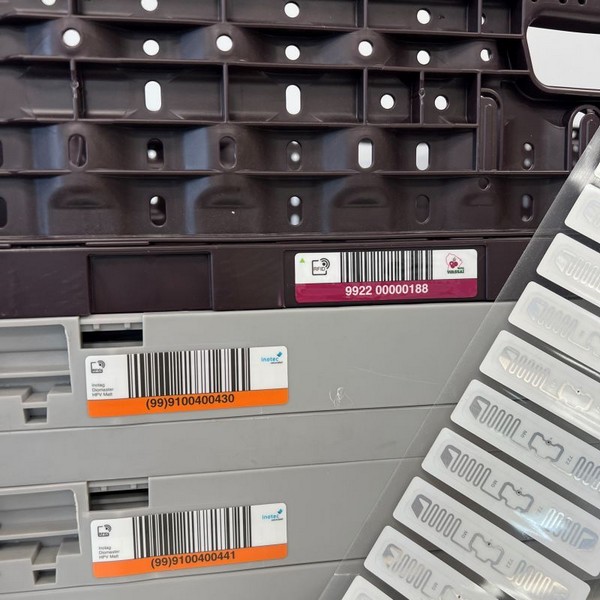
As a rule, an RFID tag for reusable transport containers is combined. It may include an RFID chip, barcode, 2D code, and human-readable number. This format is convenient for warehouse processes because the same object can be identified in several ways: automatically through an RFID portal, with a handheld RFID reader, with a barcode scanner, or visually by the printed number.
There are many types of RFID tags for warehouse use: from multilayer self-adhesive labels for plastic containers to specialized rugged RFID tags for metal with different mounting options — adhesive, screw, rivet, cable tie, or other mechanical fastening methods.
Examples of RFID tags for warehouse use
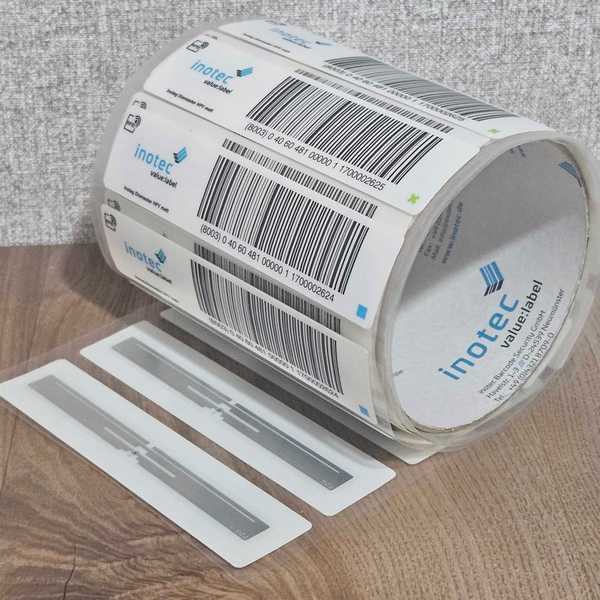
Multilayer Inotec RFID label for plastic containers
Multilayer RFID labels are used for labeling plastic returnable containers, boxes, and other logistics units. Such tags can be used in warehouse processes where resistance to wear, reliable adhesion, and the ability to combine RFID identification with visual labeling are important.
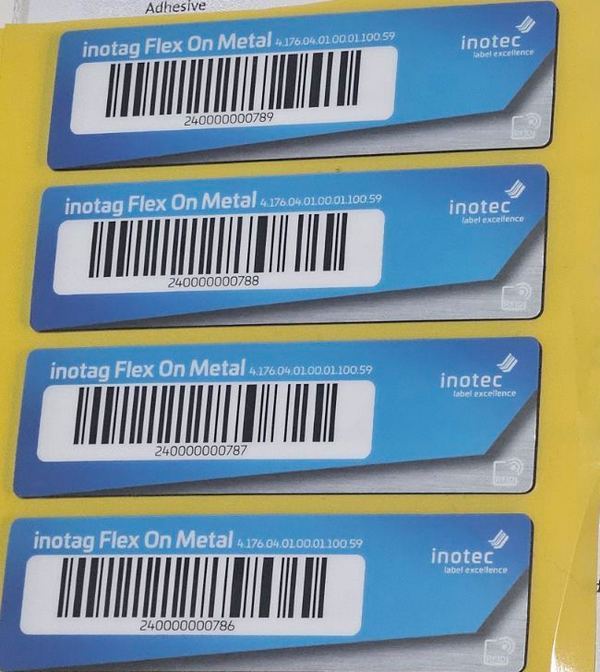
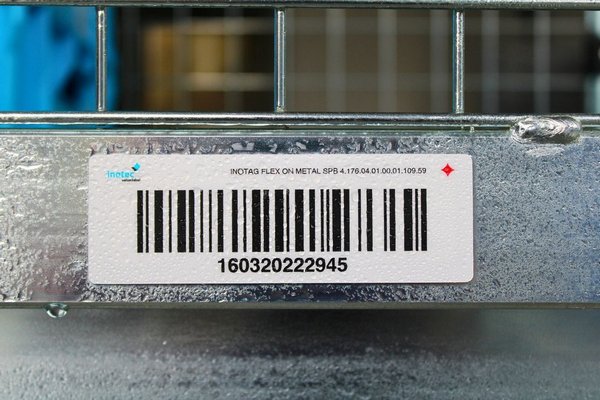
Multilayer Inotec RFID label for metal containers, racks, and storage locations
For metal containers, racks, storage cells, and other objects located near metal, special RFID tags designed to work in such conditions are used. A standard RFID label near metal may be read unstably, so special materials and tag designs are selected for metal surfaces.
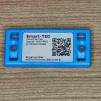
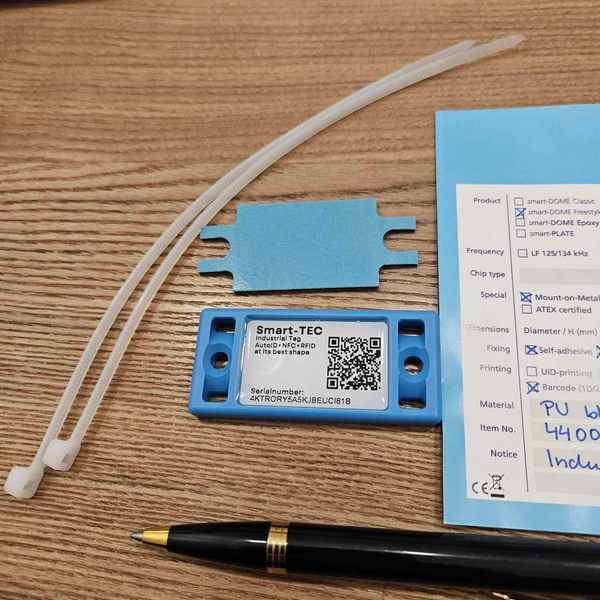
Smart-DOME Freestyle combined rugged RFID tag by Smart-TEC
Combined rugged RFID tags are used to label objects operated in more demanding conditions: transport containers, equipment, metal products, production inventory, and warehouse assets. Such tags may combine an RFID chip, NFC or HF/UHF components, barcode, QR code, serial number, and company logo.
When choosing an RFID tag for a warehouse, it is important to consider not only the price of the tag itself, but also reading reliability in real operating conditions. The tag must match the labeled object, application surface, reading distance, fastening method, service life, and RFID system operating scenario.
Combined RFID and barcode accounting schemes
Warehouse accounting schemes may differ significantly. In some projects, RFID is used only for transport and pallet control. In others, it is used to label every logistics unit, container, storage cell, and piece of warehouse equipment. RFID is often combined with barcodes and 2D codes.
For example, primary product accounting may be based on barcodes, while RFID tags are installed on transport containers, pallets, boxes, containers, carts, forklifts, and pallet trucks. During order picking, products are scanned by barcode, and the collected batch is linked to the RFID tag of the pallet or container. When the RFID tag crosses a control point, the entire batch of goods is automatically considered to have left the warehouse or been transferred to the next processing stage.
This approach makes it possible to preserve the accuracy of barcode accounting while also gaining the advantages of RFID: automatic reading, background control, faster operations, detection of missed actions, and greater transparency of warehouse logistics.
Benefits of RFID in the warehouse
- automatic recording of goods and transport movement;
- reduction of manual scanning errors;
- faster receiving, shipping, inventory, and order picking;
- control of pallets, containers, boxes, carts, and returnable packaging;
- background control of warehouse operations;
- search for lost or incorrectly placed goods;
- integration with WMS, ERP, scales, video surveillance, and positioning systems;
- increased transparency of logistics processes.
Conclusion
RFID technology in the warehouse is not just a replacement for barcodes, but a tool that expands the capabilities of warehouse accounting. It makes it possible to automatically record events, control the movement of logistics units, speed up operations, and receive additional data for warehouse management.
The most effective projects are not built around the separate installation of RFID readers, but around an integrated approach: proper labeling of objects, selection of suitable RFID tags, integration with WMS or ERP, configuration of control points, personnel training, and phased implementation. In this format, RFID becomes a reliable technological layer for warehouse logistics automation and improves the quality of operational accounting.
Products