




identytag OnMetal Global Label Mini 54 × 13 мм
Compact RFID Tags for Metal Surfaces
identytag OnMetal Global Label Mini 54 x 13 mm is a series of compact industrial UHF RFID tags designed for the identification and tracking of equipment, tools, metal containers, components and other assets with metal surfaces.
The tags are specifically engineered for direct application to metal, where standard RFID labels may suffer from reduced read range and unstable performance. Their compact size of 54 x 13 x 1.8 mm makes them suitable for assets with limited available space for identification labels.
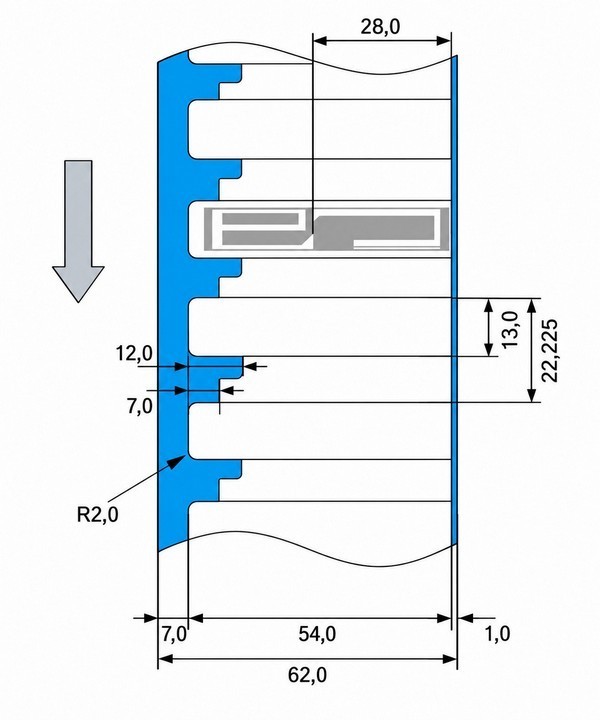
OnMetal Global Label Mini Product Variants
The series includes versions based on NXP UCODE 9xm and NXP UCODE 9xe RFID chips, as well as variants supplied either without prior personalization or with customized printing and RFID encoding.
| Part Number | RFID Chip | EPC Memory | User Memory | Supply Option |
|---|---|---|---|---|
| 103516 | NXP UCODE 9xm | 128 / 256 / 496 bit | 752 / 624 / 384 bit | without pre-printing and pre-encoding |
| 103517 | NXP UCODE 9xm | 128 / 256 / 496 bit | 752 / 624 / 384 bit | with customized printing and RFID encoding |
| 103518 | NXP UCODE 9xe | 128 bit | none | without pre-printing and pre-encoding |
| 103519 | NXP UCODE 9xe | 128 bit | none | with customized printing and RFID encoding |
Which Version Should You Choose?
For more flexible asset tracking, inventory and traceability projects, the NXP UCODE 9xm versions are generally the most versatile choice. They provide configurable EPC memory together with additional User Memory, allowing more flexibility in identifier structure and data storage.
If the application only requires a standard 128-bit EPC and no additional user memory, the simpler UCODE 9xe versions may be sufficient.
Custom Printing and RFID Encoding
The white polyester surface is suitable for thermal transfer printing and can be customized with:
- asset or inventory numbers;
- serial numbers;
- Code 128 barcodes;
- Data Matrix codes;
- QR codes;
- text and operational information;
- company logos.
Depending on the selected part number, the tags can be supplied without prior personalization for later printing and RFID encoding, or already customized with printed information and pre-encoded RFID data.
RFID + Barcode + Data Matrix
The 54 x 13 mm format makes it possible to combine RFID identification with traditional automatic identification technologies on the same label. One tag can simultaneously support RFID, a linear barcode, Data Matrix and a human-readable identifier.
For thermal transfer printing at approximately 200 dpi, the following dimensions can be used as practical guidelines:
- Code 128 — approximately 42-44 mm wide and 7-8 mm high;
- Data Matrix ECC200 — approximately 5 x 5 mm or 6 x 6 mm;
- human-readable identifier — according to the selected layout and font size.
These values are indicative. Test printing and verification with the actual barcode scanners and RFID readers are recommended before volume deployment.
Main Technical Specifications
- size — 54 x 13 x 1.8 mm;
- operating frequency — 865-928 MHz;
- standards — ISO/IEC 18000-6C, EPCglobal Class 1 Gen 2;
- read range — up to 3.5 m in ETSI and up to 4 m in FCC conditions under laboratory testing;
- surface material — white polyester;
- printing method — thermal transfer;
- adhesive — permanent acrylic adhesive;
- operating temperature — from -20°C to +85°C;
- minimum application temperature — +5°C;
- protection rating — IP68;
- RFID memory write endurance — up to 100,000 cycles at +25°C.
Typical Applications for 54 x 13 mm RFID Tags
The compact OnMetal Global Label Mini format is particularly suitable for:
- industrial equipment identification;
- fixed asset inventory and tracking;
- tool and fixture management;
- metal container and reusable asset identification;
- component and assembly identification;
- equipment and spare part traceability;
- maintenance and repair asset tracking;
- RFID inventory in production and warehouse environments.
Automated Equipment and Asset Inventory
RFID identification makes it possible to move from manual verification of asset numbers to faster and more automated inventory processes. Each physical RFID tag can be linked to a digital equipment or asset record in an ERP, EAM, CMMS or asset management system.
The digital asset record can include equipment name and category, serial number, asset ID, current location, responsible department, movement history, technical condition, maintenance and repair information, and inventory verification results.
RFID reading does not require direct line-of-sight scanning of every individual code. This can significantly improve the efficiency of inventory processes involving large numbers of equipment items, tools, containers or other industrial assets.
Selecting the Right RFID Tag
The choice of RFID tag depends on more than just size and chip type. Important factors include the material and geometry of the asset, available mounting area, tag placement, required read range, antenna orientation, operating environment and requirements for printed information.
For this reason, practical testing on the customer's actual assets is recommended before full-scale deployment. Typical tests include checking tag placement, RFID read performance, print quality and usability in real operational conditions.
Vostok-IT supports RFID tag selection, printing and encoding equipment, mobile and fixed RFID readers, and integration of RFID identification into asset tracking, inventory, traceability, maintenance and equipment management systems.
Products