




Industrial Hard RFID Tags for Metal Surfaces
Industrial hard RFID tags for metal surfaces are used for identification, asset tracking and automated inventory of equipment, metal containers, reusable transport items, railcars, tanks, tools and other industrial assets.
Unlike standard RFID labels, RFID hard tags use rugged constructions designed for mechanical stress, contamination, moisture, temperature changes and long-term industrial operation. Depending on the application, they can be mounted using adhesive plates, industrial adhesives, screws, rivets, bolts or cable ties.
When Are Hard RFID Tags Required?
Printable on-metal RFID labels are well suited for equipment and fixed assets when the mounting surface is relatively flat and mechanical loads are limited. In harsher operating conditions, however, rugged RFID hard tags are often the better choice.
Typical applications include:
- metal containers and reusable transport items;
- railcars and tank cars;
- metal tanks and cylinders;
- production carts and industrial trolleys;
- kegs and reusable metal containers;
- machinery and heavy equipment;
- tools and industrial fixtures;
- outdoor assets and equipment used in harsh environments.
RFID Tags for Metal Equipment and Mounting Options
A hard RFID tag for metal can serve as a permanent identifier of an industrial asset and support automated tracking of its location, movements and operational history.
Depending on the object and operating environment, hard RFID tags can be installed using:
- screws;
- bolts;
- rivets;
- industrial adhesive;
- self-adhesive mounting plates;
- plastic cable ties;
- combined mounting methods.
Mechanical fastening is especially useful for assets exposed to vibration, impacts, washing, outdoor conditions or long-term operation.
Smart-DOME Hard RFID Tag with Multi-Identification
A modern hard RFID tag can provide much more than a single RFID identifier. A good example is Smart-DOME Freestyle F6630 Industrial UHF, an industrial on-metal RFID tag for equipment, containers, reusable assets and other physical objects.
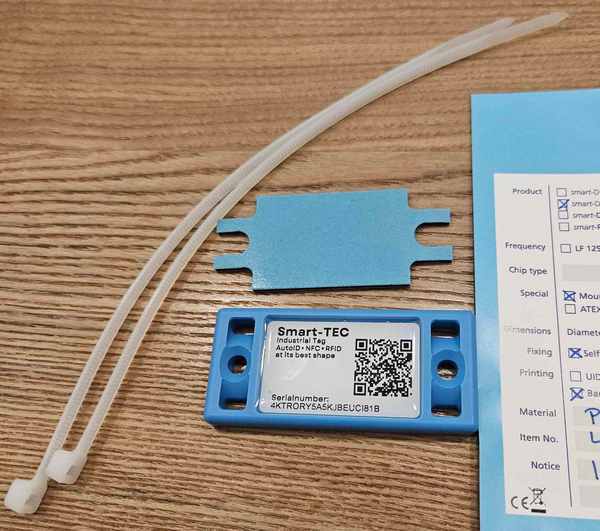
The tag can support a multi-identification approach, allowing the same physical asset to be identified in several ways:
- UHF RFID — for remote automatic identification and inventory;
- NFC / HF — for local identification in compatible versions;
- linear barcode — for standard barcode scanners;
- Data Matrix or QR code — for compact machine-readable identification;
- human-readable number — for visual verification;
- web-based asset passport — direct access through Data Matrix or QR code to the digital record of the equipment, container or other asset.
This allows the same tag to be used across different business processes. RFID can support automated inventory and portal-based movement control, barcode or Data Matrix can be used for local scanning operations, while the web passport provides direct access to digital asset information for employees, maintenance personnel or other authorized users.
In this way, the hard RFID tag becomes a single identification point for the physical asset.
Multiple Mounting Options for One RFID Tag
Smart-DOME Freestyle F6630 Industrial UHF also demonstrates why tag mounting should be selected according to the actual asset and operating conditions.
The same RFID tag can be installed using different methods:
- adhesive plate or industrial adhesive — for flat surfaces where mechanical fastening is not required;
- screws, bolts or rivets — for equipment, containers and assets requiring durable long-term installation;
- plastic cable ties — for frames, pipes, mesh structures, cables and objects where drilling or adhesive mounting is undesirable.
For this reason, RFID tag selection should consider not only frequency, read range and protection rating, but also the actual mounting method on the asset.
Why Hard On-Metal RFID Tags Differ from Standard RFID Labels
Metal significantly affects the electromagnetic performance of conventional RFID antennas and can reduce read range or make standard labels unstable or unreadable.
On-metal RFID tags use specialized constructions designed to operate close to metallic surfaces. Depending on the tag, this can include a dedicated antenna structure, dielectric or shielding layer, rugged housing or another technical design optimized for metal mounting.
Industrial hard RFID tags may also provide:
- high impact resistance;
- protection against dust and moisture;
- resistance to chemicals;
- operation at high and low temperatures;
- resistance to vibration and mechanical wear;
- multiple permanent mounting options.
Passive RFID Tags Without an Internal Battery
Most industrial hard RFID tags used for asset tracking are passive devices. They have no internal battery and receive energy from the signal generated by an RFID reader.
This allows the tags to operate for many years without battery maintenance. Depending on the RFID chip and system configuration, a unique identifier and additional operational data can be stored in the tag memory.
The RFID identifier can be linked to an asset record in an ERP, EAM, CMMS or dedicated RFID inventory system.
RFID Tracking of Metal Containers and Reusable Assets
One of the most useful applications of hard RFID tags is the identification and tracking of metal containers and reusable transport items.
Each asset can receive a unique RFID tag linked to a digital passport containing:
- unique container ID;
- type and purpose;
- current location;
- responsible department or production area;
- movement history;
- number of usage cycles;
- technical condition;
- cleaning and washing history;
- repair records;
- current or previous contents;
- inventory verification results.
This makes it possible to manage not only the presence of an asset, but also its complete circulation between production areas, warehouses, branches or different companies.
RFID Tags for Railcars, Tanks and Heavy Equipment
Large metal assets such as railcars, tanks, industrial vessels and heavy machinery require reliable read performance, strong mechanical construction and secure mounting.
For these applications, larger hard RFID tags designed for outdoor and long-term industrial use are typically selected. Depending on the project, they can be installed using screws, rivets, bolts or industrial adhesive systems.
Hard RFID Tags or Printable On-Metal Labels?
Different assets require different RFID identification technologies.
| Application | Recommended RFID Tag Type |
|---|---|
| Equipment and fixed assets in indoor environments | Printable on-metal RFID label |
| Limited mounting space | Compact on-metal RFID tag |
| RFID + barcode + Data Matrix + text | Printable or hard RFID tag with multi-identification |
| RFID + Data Matrix / QR + web passport | Multi-identification RFID tag |
| Containers and reusable transport items | Protected or hard RFID tag |
| Heavy impacts, vibration and mechanical wear | Rugged RFID hard tag |
| Railcars, tanks and heavy machinery | Industrial hard RFID tag |
| Screw, rivet or cable-tie mounting required | Hard RFID tag with suitable mounting design |
For this reason, RFID tag selection should start with the asset, operating environment, mounting method and business process rather than with a specific RFID model.
Automated RFID Inventory and Movement Control
RFID makes it possible to move from manual identification to automated inventory and asset movement control.
Depending on the application, the system may use:
- handheld RFID readers;
- mobile RFID terminals;
- fixed RFID readers;
- RFID workstations;
- RFID gates and portals;
- automated asset movement control zones.
This is especially useful for large populations of similar containers, reusable assets, tools or equipment where manual identification is slow and increases the risk of errors.
Web-Based Asset Passport as Part of Multi-Identification
When Data Matrix or QR code is included on the RFID tag, it can provide direct access to a web-based asset passport — a digital record for equipment, containers, tools or other physical assets.
A specialized RFID reader is not required to open the web passport. The code can be scanned using a smartphone or standard barcode scanner.
The digital passport can provide access to technical specifications, serial number, current status, location, maintenance history, documents, photographs and other information required by operators or service personnel.
RFID Tag Selection and Testing for Metal Assets
Even specialized on-metal RFID tags should be tested on the actual asset before full-scale deployment.
RFID performance can be affected by:
- metal type and thickness;
- asset geometry;
- tag mounting position;
- tag orientation;
- RFID reader type and transmit power;
- antenna location;
- required read distance;
- temperature, moisture, contamination and mechanical stress.
Practical testing helps select not simply a tag with suitable datasheet specifications, but an RFID solution that performs reliably within the real production or logistics process.
Vostok-IT supports the selection of printable, flexible, rugged and hard RFID tags for metal assets, testing on real equipment, selection of RFID readers and integration of RFID identification into asset tracking, inventory, traceability, maintenance and equipment management systems.
For RFID tag selection and project inquiries, contact us at vostok@pkf.dp.ua, use our contact form, or call +380 67 384 69 83.
Products