





Production Traceability Automation for Window and Door Hardware
Production traceability from raw materials to finished products
This comprehensive project for the automation of workplaces across the production and warehouse departments of a window and door hardware manufacturing plant started in 2023 and continues to evolve today. The system is gradually being expanded to cover new production areas, workplaces, and processes while also creating a foundation for further modernization of the enterprise.
The main objective of the project is to create an end-to-end serial-number-based production traceability system: from the receipt of raw materials and supplies through to the production and delivery of finished goods to the customer.
Enhancing the existing enterprise management systems
At the start of the project, the enterprise already had a fully operational management accounting system as well as a maintenance and repair management system.
As part of the pre-project study, specialists from Vostok-IT worked together with the plant’s employees to analyze the existing business processes and develop a solution architecture that would not replace the existing information systems, but rather complement and strengthen them.
A separate operational accounting system was added alongside the management and technical systems. Its database does not contain commercial or accounting information. Its primary purpose is to capture real production events in maximum detail directly at the points where they occur.
Serial accounting of raw materials, semi-finished products, and finished goods
The operational system provides for assigning serial numbers to individual accounting units, starting with packages of incoming raw materials and supplies and continuing throughout the entire production chain.
As production operations are performed, the system builds a continuous history of the movement of raw materials, semi-finished products, and finished goods between warehouses, production areas, and individual workplaces.
As a result, the complete manufacturing history of a finished product can be reconstructed from its serial number, including:
- which raw materials and supplies were used;
- which production operations were performed;
- which machines and production areas were involved;
- which employees participated in production;
- which batches and series of semi-finished products were used;
- which quality control operations were performed during production.
Traceability as a quality control tool
Serial operational accounting significantly extends the capabilities of the quality control system. If a non-conformity is detected, it is possible not only to identify the relevant batch of finished goods, but also to trace the associated materials, equipment, production operations, and the participation of specific employees.
This level of detail makes it possible to analyze the causes of deviations, identify recurring problems, and gradually build objective statistics on production quality.
A foundation for operational production cost control
One of the promising directions for further development of the project is to move from controlling only the quantity and quality of production toward operational control of production costs.
For this purpose, the operational accounting system has been integrated with the maintenance and repair system, which records maintenance activities for production equipment as well as the use of dies, tooling, fixtures, and tools.
Linking information about machine setup and maintenance to specific production batches and serial-numbered parts makes it possible to allocate maintenance, repair, and tooling costs directly to the products being manufactured.
This creates an information foundation for a more detailed calculation of actual production costs.
Actual production data for KPI and employee motivation
Production serialization and the registration of employee participation in specific production operations make it possible to use the system not only for product accounting, but also for analyzing actual staff performance.
The accumulated data can serve as a basis for developing KPI and motivation systems based not on subjective assessments, but on real production indicators such as the number of completed operations, output volumes, quality, compliance with technological requirements, and other measurable parameters.
First implementation stage — Semi-Finished Products Warehouse
The Semi-Finished Products Warehouse was selected as the first implementation point. This area was one of the key information and material hubs of the enterprise, as a significant share of the parts and semi-finished products manufactured and further processed at different production areas passed through it.
The warehouse interacted with the main production areas, including:
- press operations;
- machining;
- casting;
- electroplating;
- painting;
- subassembly;
- quality control;
- finished product assembly;
- raw materials and auxiliary materials warehouses.
In practice, the Semi-Finished Products Warehouse acted as a central information hub for the movement of raw materials, parts, semi-finished products, and supplies between production areas.
Automated workplace for the semi-finished products warehouse
Before modernization, a significant share of warehouse accounting was performed by weight, with subsequent conversion of the measured weight into the number of parts. After that, quality control employees carried out product inspection.
Three types of electronic scales were used for different operations:
- floor platform scales for weighing containers;
- warehouse floor scales for weighing products in boxes;
- checkweighing scales for verification weighing and conversion of weight into piece quantity.
All scales were connected to the enterprise computer network, while the accounting operations were combined in a single interface of a stationary automated workplace.
At the same time, document workflows were modernized using barcode identification, which accelerated the identification of documents, production batches, and manufacturing operations.
Transition from a stationary workplace to a mobile one
After the processes had been fine-tuned at the stationary workstation, a mobile automated workplace for the semi-finished products warehouse employee was developed on the basis of a mobile data collection terminal.
This made it possible to move a significant share of operations directly to the locations where products are stored and moved, reduce the number of intermediate actions, and register operations at the moment they are actually performed.
The transition to a mobile workplace also required further development of reliable identification methods for internal production containers and storage locations.
Labeling of internal production containers and storage locations
A separate area of the project focused on developing a reliable labeling system for internal production containers and storage locations. Vostok-IT specialists, together with the plant’s employees, analyzed the containers, boxes, production bins, racks, and other objects that had to be reliably identified during the movement of raw materials, semi-finished products, and finished goods.
During the system launch and fine-tuning stage, temporary labels were used. This made it possible to verify the identification logic, label placement, employee convenience, and the practical viability of the selected approach under real production conditions without making premature investments in permanent marking solutions.
To prepare for industrial operation, samples of specialized Inotec labels designed for long-term use in demanding production environments were obtained.
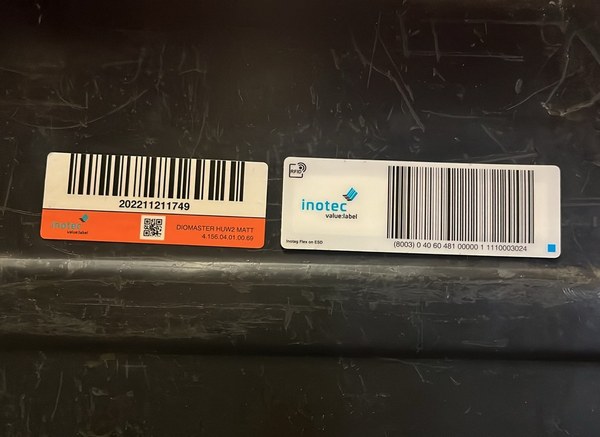
Samples of Inotec industrial marking solutions selected for testing within the project.
Practical tests were carried out on different types of production containers, taking into account surface materials, operating conditions, possible contamination, mechanical impact, and the requirements for stable barcode readability.
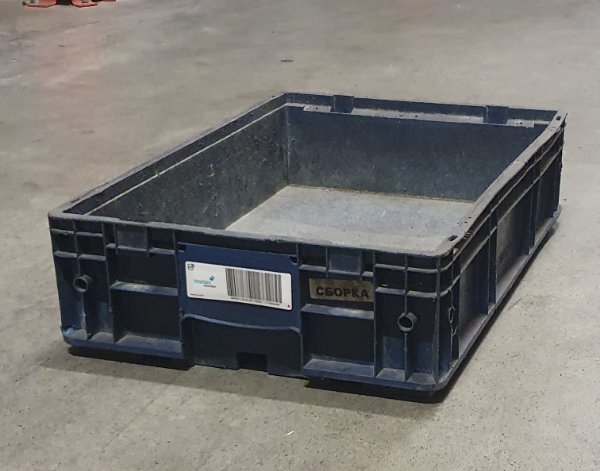
Practical testing of the selected Inotec labeling solution on a plastic production container.
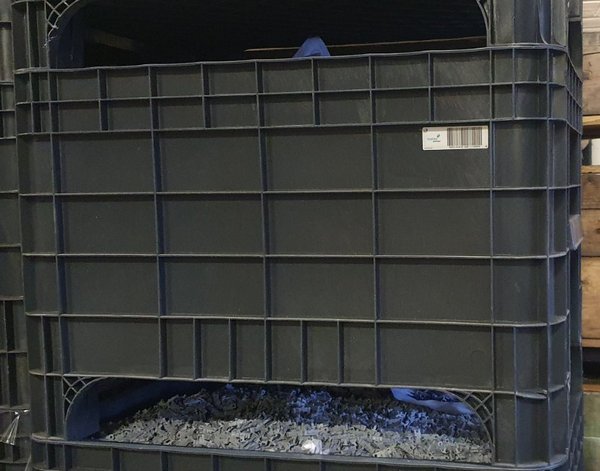
Practical verification of the labeling solution on a large internal production container.
Based on the test results, a phased transition from temporary labels to permanent, highly durable Inotec marking solutions is planned. This will make it possible to assign a long-term unique identity to production containers and storage locations and increase the reliability of the entire operational accounting and traceability system.
A working model as an implementation tool
The automated workplace that was created was used not only for practical accounting and control tasks. It also became a working demonstration model for employees from other production areas.
Using a real operating example, employees could see how the new system worked, which operations it automated, and how it interacted with the existing production processes.
This approach significantly accelerated further implementation. Employees from other areas were able to understand the principles of the system more quickly and provide concrete suggestions on how their own workplaces should be automated.
In practice, employees who work directly with parts, equipment, and production operations often understand the nuances of the process better than anyone else and can provide valuable input on how accounting and control should be automated at a specific workplace in the most convenient and efficient way.
Gradual expansion of the system
After the first operational module was launched, the system began to expand gradually to other production and warehouse departments of the enterprise.
The core principle of the project is not the simultaneous replacement of existing processes, but the gradual integration of operational accounting into the existing information infrastructure, with solutions being tested directly under real production conditions.
As a result, a unified traceability system is being created that combines the movement of raw materials, production operations, equipment activity, employee participation, quality control, warehouse processes, and finished product output.
Further development of the project
The project continues to evolve. As more data is accumulated and additional production areas are connected, the next levels of automation include more detailed quality control, analysis of equipment and employee efficiency, operational production cost control, further development of KPI systems, and deeper integration of operational accounting with the enterprise’s corporate information systems.
This approach allows the system to develop gradually — from individual automated workplaces to an end-to-end digital operational environment for the enterprise — without disrupting existing business processes and while making maximum use of the corporate information infrastructure that is already in place.